
Despite the world appearing to be coming apart at the seams, I have dear friends who are having babies. Not second babies. First babies. Babies who were created through love and optimism that perhaps the world is ok, or is going to be ok, or can be made ok. My eldest son turned 13 recently and I think a lot about that: about my fear and my optimism when he was born and how those fears and that optimism have evolved over the course of his life and our life together. I am in awe of the 2024 mothers. Despite it all–everything we’ve experienced, everything we know, and everything we suspect about the years to come–they are ushering new life into space. (And yes, I’m talking about the women who are actively exercising the choice to give birth. Not women forced to do so by state governments. Don’t bring no nonsense up in here.)
Anyway.
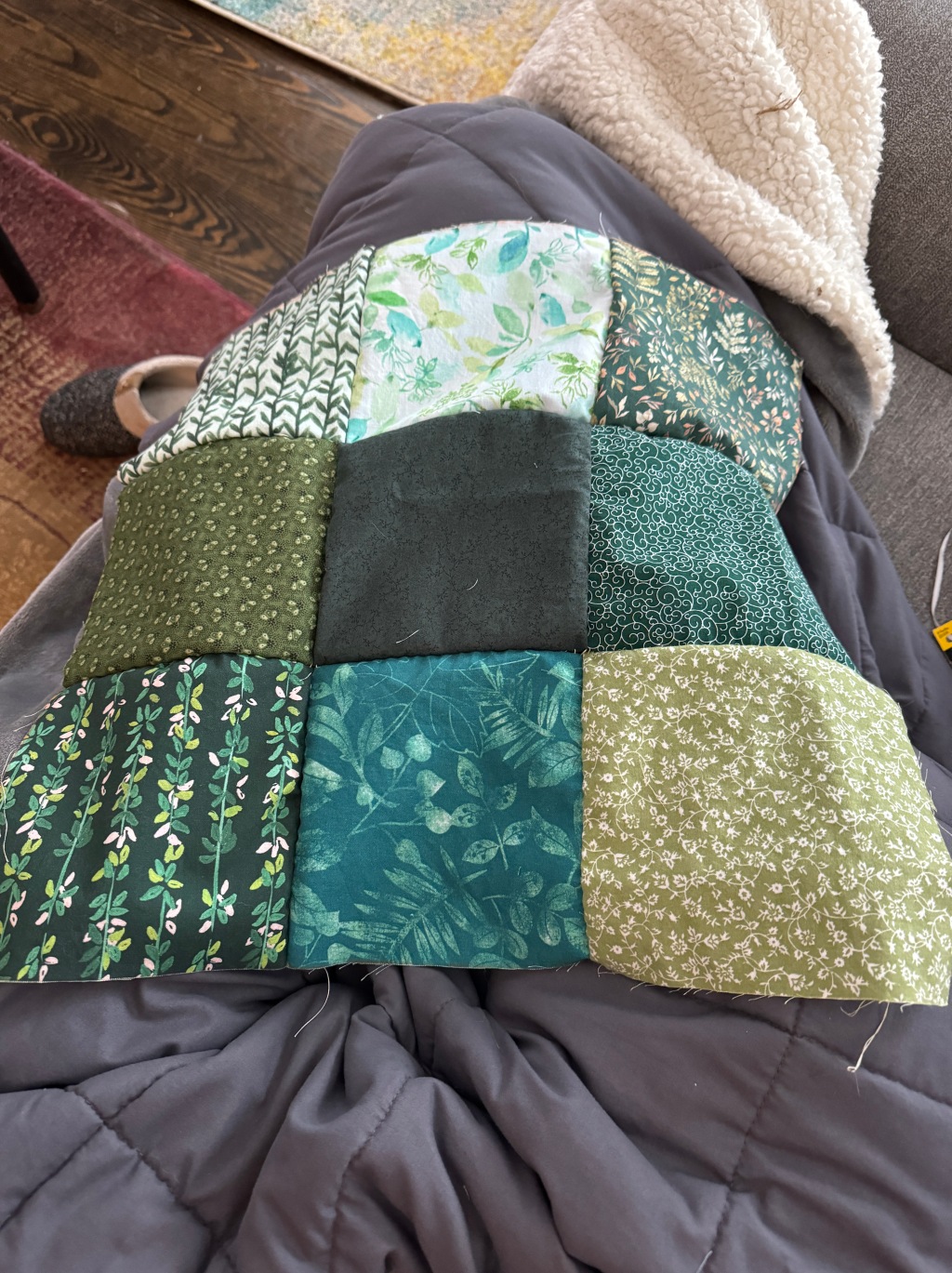
Two dear friends are having babies. In 2024. Very soon. And new babies deserve to be honored and welcomed with a handmade thing. I’ve been knitting and I’ve been quilting. Each stitch, be it looped over two needles or pulled through patterned fabric, is a happy thought, a little blessing, a thoughtful (and hopeful) prayer. I have been listening to audiobooks while I do my crafting. My audiobooks over the last few weeks have been novellas: The Sorcerer of the Wildeeps by Kai Ashante Wilson, A Psalm for the Wild-Built by Becky Chambers and Exit Strategy by Martha Wells. They were all short (by their nature) and they each packed a punch. I’ve moved on to another novel, The Parable of the Talents by Octavia E. Butler, in preparation for my upcoming talk at GrubStreet’s Muse & Marketplace conference in May.
Just like the threads of my crafting projects, this all connects. Experiencing the intangible while doing something tangible is how I do my best work. I take my knitting to meetings and give my fingers a rhythm while my brain deals with the tangles of problems presented to me. Sentences and paragraphs of literature tickle my brain differently when my fingers are occupied and row and after row pass across my needles. Thanks to these hours of intentional working and thoughtful listening, I found the perfect source materials for my first-ever GrubStreet class!
That’s right! I taught my first class at GrubStreet last week, exploring the Dark Night of the Soul and how to land it effectively. I have an affinity for this beat in stories: it’s the place where a story fulfills its thematic promise and delivers on its purpose. Not every story has a moral. That’s fine. But every story has a purpose and a reason for us to see it through. When we get to the Dark Night of the Soul, we witness the protagonist of the story go through that all-important moment of change or non-change. I believe that both outcomes are valid and entertaining, by the way!
It’s funny, thinking of the Dark Night of the Soul as I reflect on my eldest child turning 13. These teen years are already so full and fraught. But I will always remember the morning before I went to the hospital to deliver that child. I stood in the living room of our little one-bedroom apartment with my husband, my suitcase packed, my birth plan memorized. A blizzard was coming, and I was starting to dilate. We were going in early to make sure baby wasn’t born at home in a blizzard. But I didn’t want to go. I wasn’t ready to face it. “This was all a bad idea,” I remember saying. “I don’t want to do it.” It was nonsense. My husband looked at me with such empathy and love and confusion. There was no way put of it all. There was a baby and he needed to be born. I could go to the hospital and birth the baby or I could not and face all of the (very negative) consequences. The confession of it all mattered. It was the first time I admitted to being afraid. I confronted the final houses of being myself and not a mother with fear and worry. We got to the hospital and I gave birth to a healthy boy. We were lucky. I am forever grateful.
I used A Psalm for the Wild-Built as the key source for my class because I think it offers a fantastic example of how to bring a character through a journey, present them with a moment of (perceived) failure, and require their reconsideration and even confession before moving forward. Psalm is a beautiful meditation in novella form, with a monk and a robot, philosophy and theology, and a beautiful question that is asked over and over again: what do humans (what do we, individually and collectively) need? To be whole? To be happy? To be content? To be. And I loved it. I loved how it was performed in audiobook and I love it in book form. It’s a phenomenal book to teach with. I used other texts, too. Ted Chiang’s The Merchant and the Alchemist’s Gate from his Exhalation collection, Elizabeth Acevedo’s Family Lore, and even a bit of Uzma Jalaluddin’s Ayesha at Last, which is one of my favorite romance books ever. I thought about the books I love that delivered a thoughtful lesson, a significant moment of pause and reflection, and didn’t skip over this crucial part of the story. I come to story to “learn how to be more human,” as Lisa Cron puts it. These stories, each of them in their own way, taught me how to do that. I know that there are rumblings in the internetz about stories not needing a moral or a lesson or a theme. That stories that have purpose are old-fashioned or not worth our reading. I hope that doesn’t catch. This is, I strongly believe, the entire purpose of why humans tell stories. Indeed, why humans are humans. If you want to know more about that (and be more thoughtful about your storycraft), I highly suggest reading Lisa Cron’s Wired for Story or watching her TEDx talk by the same name. (I do not recommend her book StoryGenius, which puts the theory behind Wired for Story into practice.)
Which brings me back to the little humans. The new ones being born in 2024. They’ll be born to a world full of humans–humans who we know and love and lament over. Humans who we miss because we’ve been separated from them for moral or philosophical reasons, or for reasons of state, politics, the result of leaders and their decisions. Our hopes and dreams for these precious little ones are so intangible while the frustrations of this world in this moment are very tangible. Through my stitches, I manifest my hopes and dreams for two precious little ones into something they will be able to feel with their little fingers. They’ll be wrapped in the warmth of my hopes and dreams for them. They’ll know my love for them, hundreds of miles away. And you know the best part? Through them and my gifts for them, I, too, feel a bit of optimism. Perhaps, through them, the world will be a better place.
For writers, the Dark Night of the Soul is a strangely optimistic moment in any story. It’s the moment when we infuse a bit of our own humanity, the hard-earned lessons that have shaped our view of the world, and even our hope for future humans and how they interact with the world. When was the last time you wrote a Dark Night of the Soul scene (or chapter? or chapters?)? How did you feel afterward? How did that moment in your story reflect you and your experience? If you haven’t written one in a while, I hope that you’ll consider doing so. This world, right now, needs our hard-earned lessons, our tattered hope, our tender optimism, our preciousness.
 Multiplicity: A Writer's Blog
One response to “Tangible, Intangible, and Precious Optimism”
When I wrote the Dark Night of the Soul for my last novel, I was practically shaking the entire time. I knew what I had to write and it was both devastating and a release (both for me and for my protagonist). I really like the idea of this being a direction to point the story toward, for the times when I’m not sure what comes next in a project. Thank you for this beautiful, rich reflection.
LikeLike