
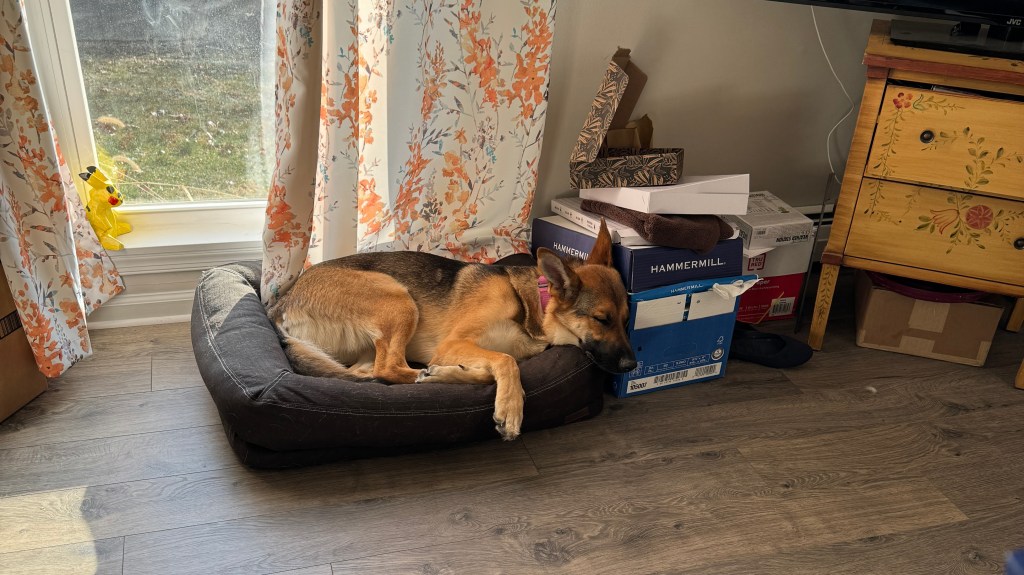
Photo: Puppy catching a nap this morning. This photo was taken an hour before the workmen showed up to start putting solar panels on the roof. Barking. Hammering. Drilling. Music from all sorts of genres (all the songs are bangers–I give them credit for that!) pumping into the living room via the chimney. I knew this would happen, so I absorbed as much quiet as I could. It was… just enough. Just.
My mother, like most of the cooler people who walk the Earth, ran her college radio station back in the wayback. She lights up when she talks about music: the music she listened to in high school and college, the music she listens to now… she watches the Grammys every year with a level of excitement that I’ve never really understood. (“I’m watching it so you don’t have to!”) I always say to her, “I don’t know who any of those people are anymore! It makes me feel old!” and she says, “That’s half the fun!” My mother wasn’t a music major (that was my father), and I think that’s what makes her passion about it so accessible and wonderful. When Mom talks about music, she talks about memory. She talks about vibe. She talks about where she was, who she was, and how she was when she was listening to a song.
Mom sometimes laments about the way we listen to music now and the specific cuts we hear. She talks about song versions that have been lost to time that she remembers vividly and misses. There were songs she used to listen to on record where the tracks had breathy sounds or grunts in rhythm or little “yeah!” and “wooh!” and other sounds on the track from the recording, sometimes so soft you can’t hear them unless you know the moment. Again with memory–those insertions are moments when an artist was being an artist and the joy couldn’t be contained, you know? A lot of our digital stuff misses that. Or we’re listening in the car and we can’t hear it. Something is lost when this happens.
Last week, I spent my time scrubbing bathrooms and vacuuming floors. I put on my good headphones and put on my playlist: an eclectic list of Millennial favorites, video game music, and stuff from the old school, my Mom’s school. A lot of songs on my playlist is the stuff I used to listen to as a little girl listening in the backseat of Mom’s car. I listened for the breaths and the grunts and the “yeah!” and the “woohoos!” in my music and in hers. I really listened to Nina Simone. I actually listened to Amy Winehouse. I found things in there. New things. And I remembered the vibe and the who and the how of who I was when I first heard those songs and the why I keep them on my playlist.
That was a long setup, but this really does have to do with writing. I write thinking a lot about how my work sounds. My bucketlist dream is that LeVar Burton or Kevin R. Free reads my work in a podcast or audiobook someday. I think about where emphasis could go. Where song and rhythm can play in a paragraph. I think about this when I’m drafting and when I’m revising. When I listen to audiobooks, which is a lot, I enjoy hearing where readers add emphasis and how they do so. How words transform in the mouth and how sentences get a pleasant bumpity bump or an incomprehensible thud. Most recently, I listened to Kai Ashante Wilson’s The Sorcerer of the Wildeeps (read by Kevin R. Free, who is a master), and it took my breath away. It’s beautiful on the page, but it’s an opera to listen to. It’s glorious. I think of the traditions of oral storytelling and how Black people do it so well and so purposefully. When I write, I write for breath and deep notes.
A lot of new writers are told and then reminded to read their work out loud while they are revising so that their ears can find things that their eyes have missed. It’s very good advice. I add a twist: I think that writers should consider performing their reads. Add that extra layer. Read it as you’d intend for someone else to hear it. Either in their head or read out loud by someone who is a master at it or just someone who is reading books out loud (like at say, a school, or a nursing home, or a monastery. YES, a monastery. Did you know they sometimes read books out loud at lunch and dinner there? I do! I’ve witnessed it! Seriously–imagine your story read in a place with acoustics designed to amplify and accentuate the sound of chanters! Game-changing, right?).
What is lost when your reader can’t hear your breath? What’s lost when that grunt of joy or that extemporaneous woohooo goes missing? What happens when you’ve got it in an early draft and you take it out for a later one and someone notices?
You’re thinking to yourself: I don’t have time for that. Or maybe: I let MS Word read to me in its robot voice and that’s fine.
You’re probably right. You probably don’t have time for that. And the robot is probably fine. I’ve done it in a pinch. Sometimes, it’s enough.
But I wonder… When you do have the time and the robot is not enough… how does your work change? What scenes leave you breathless? What sentences make you slow down and linger on a note? Who makes you speak in your accent from home? And now that you’ve heard those things… what will you do with your story next?
I hope you’ll let me know.
Want to know more about this? I’m teaching Writing to be Heard at the Women in Publishing conference on March 9th at 4pm Eastern! You can learn more about it here and even get your ticket!
 Multiplicity: A Writer's Blog