
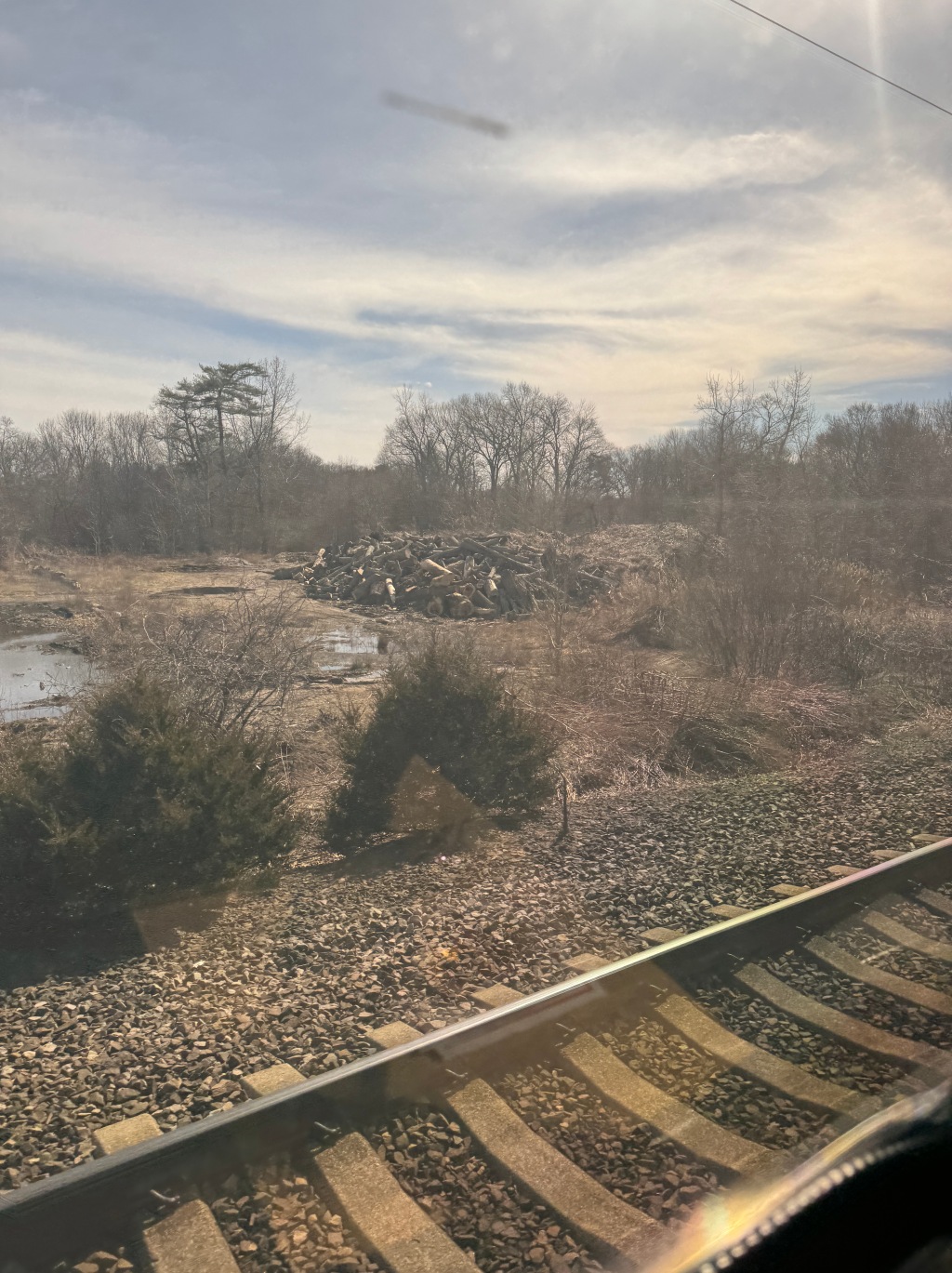
When I go to Boston, I take the train. I splurge on the first class ticket because I like having a day when the bourbon comes to me for once. 🙂 Sometime in the future, I’m going to write about this, but it’s really expensive to be an introvert. That’s another post for another time.
The best part about taking the train is the big windows and the constantly changing scenery. Train riders are romantic about this and I think we are for a reason. You see a lot on the train. More than you would on a plane, of course, but also more than you see in a car. Highways, ribbons laid on the landscape for our convenience, take up so much space and go to very specific places. We clear the land to make them. We erase so much so that they may exist. So much is lost when a new road is laid down. Access, beautiful as it is, comes at a cost.
Trains, though, at least here in the East, have been built around. They were built for us to back up to, to throw stuff on, to see things off to far off places as quickly as (then) possible. Therefore, the rails come near to places. They reveal secret places. They show a touch of the past. If you take the train between DC and Boston, there are moments that are like that scene in Spirited Away when the train seems to be floating on water. There are other times, though, when you glimpse the makeshift tent community strung together on a hill by a river, the burnt-out grills and lawn chairs next to restaurant dumpsters. The trailers, lean-tos, and lonely RVs in unexpected wooded and clear places.
Graffiti is a mainstay of any train ride. Most is indecipherable, but many reveal conversations that folk are or were having between themselves. I love those. I love that there are quiet places where, in the dead of night, someone is writing or drawing and someone else will respond in kind just a few days later. I love that someone is, as I write at sunset, preparing for a night of being out and about, amongst the skunks and the mice and the foxes and the dogs. I imagine them moving among the fences and the borders of the curated world we live in, ready to make a mark and let the world know they’re here. And alive.
Trash is a mainstay of any train ride, which is sad. Everywhere there are humans, there is detritus. That’s most distressing to see in the otherwise “untouched” places where trains go. The ones that are deep in a forest or in wetlands or otherwise away from where we should be. It’s always that unhappy glint of plastic. The shimmer of pieces of glass. One could argue that this leaving is haphazard, unintentional, even chaotic, and therefore relatively unremarkable. But that makes it worse for me. Everywhere there are humans, there is detritus. It’s a sad thing. It’s a thing we should think about more.
Then there are the abandoned places. The places where the detritus really was left on purpose. Heaps of scrap metal left by the side of the railroad. Train cars dating back to who-knows-when left to rot on a side track that no one can reach and no one cares about. Piles of superfluous wood meant to be set down to support the rails (or the fences?) long abandoned because they weren’t needed and it was too much to take them to the next job. If you look carefully, there are whole sections of towns that the railroad passes where buildings are long abandoned, their names still painted on the brick but the windows are boarded up. There is a place where old factory walls stand, but there is no roof and there are abandoned cars and growing plants inside. Not far from it, there are rstore fronts with metal coverings plastered with graffiti. The saddest places are the row homes with doors that haven’t been open in a long time and windows that haven’t seen glass in a long time. I know these homes that are still homes… even if they aren’t “supposed” to be. To all sorts… human and non.
And I know there is an ugliness to this. There is absolutely an ugliness to this. It makes my mind whirl and whirl.
I’m a writer who live in very curated spaces. I live in the suburbs. I hang out in the fancier places. I’ve been taught that there are places where I shouldn’t go and I comply. I take first class train rides. I am so fortunate as to encounter the messy in fleeting glimpses, mere seconds at a time, as I fly past them on a moving train.
As a writer, this does three important things for me: I’m reminded to stay curious about the uncurated space. The spaces that are alive when it’s dark, and it’s scary, and it’s uncertain. The spaces that are unmanned, but can be manned, and are, outside of the “acceptable” bounds that curated people like myself seem to set. I am also reminded to hold empathy and humanity for these uncurated spaces. Wherever there are humans, there is detritus. That means humans live in uncurated spaces. Treat them as such. Tell their stories. Detritus is, indeed, an inevitable result of wherever we go. Hold the planet. Know it. Tell its story, too. Finally, I commit to write more uncurated spaces–which will be a challenge, because it means I have to break out of my comfort zones and go find those spaces. This is important to me because we tell so many stories about the curated folk who live in the suburbs. We’re endlessly fascinated by the relatively shallow nature of their lives. But so many of us, so many of us, live in uncurated spaces. Among the detritus. In the places on the edges that we don’t think about.
So much of our world is uncurated. So many of our stories are echoes in our abandoned spaces.
I hope that you will keep your eye open to the abandoned, yet occupied, spaces around you. Along the railroad tracks, or along the trails, or around the urban corner. Be curated, dear writer, but be curious. Story is never so far away.
 Multiplicity: A Writer's Blog