
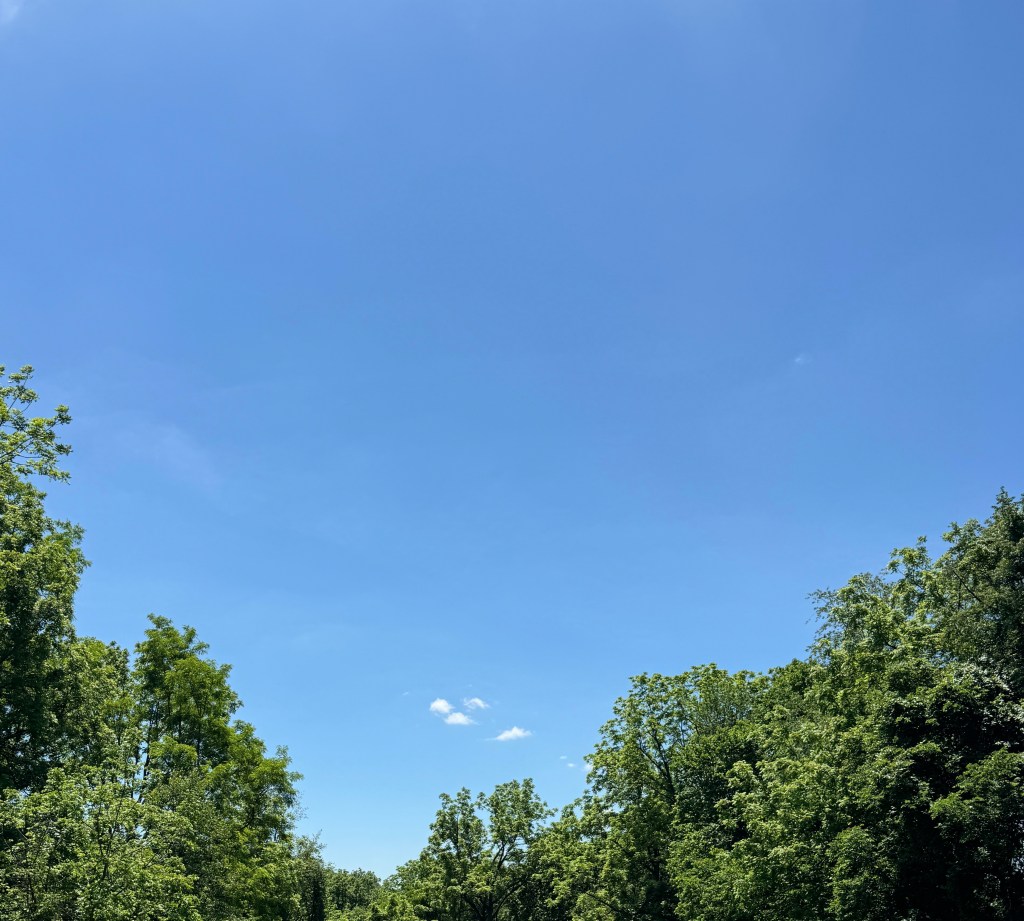
Photo: A perfectly clear blue sky over Maryland on a very normal day. I often describe days with that color sky as “technocolor perfect.” That’s the thought I had on that Tuesday morning in 2001: it’s a technocolor dream kind of day. I don’t know how many other East Coast folk who remember that day also look up at perfectly blue skies and feel the pang of memory, an echo of the trauma, a very short moment of wariness… “Last time the sky looked like this…”
It occurs to me that my children will talk to their children about COVID-19 they way I talk to my children about 9/11. Their children will learn about COVID-19 in a streamlined, matter-of-fact way in a textbook. The years will be reduced to paragraphs on glossy paper, a few carefully selected pictures interspersed. If they’re lucky, they’ll get a couple video clips with news reels spliced together to paint a broad picture. Perhaps, if their teacher is good at their job, they’ll bring in some “primary sources:” Blog posts, tweets, and youtube videos of people being candid about their experience.
I imagine my boys doing their best to infuse some of the actual emotion of the moment, saying things like “it was really scary,” and “we were confused and it was weird and it was scary.” I imagine them trying to do their best to convey their feelings without scaring their children. That balance is so important. It’s hard to achieve.
My children have learned about 9/11 from textbooks. They’ve received a streamlined, matter-of-fact, sanitized version of the events of that day on glossy pages with photographs interspersed. I am still surprised that 9/11 is in textbooks. How often are those made and updated? Right, of course, every year. Right, right. History doesn’t stop just because you stop looking at textbooks in school.
When my children ask me about 9/11, I do my best to infuse some of the actual emotion of the moment: I watched the plane fly into the second tower live on television. I remember not fully understanding what I saw. I watched both towers fall while sitting in a high school piano class, some of us cried, most of us just watched with our mouths hanging open… because it was so incomprehensible. When we heard about the plane slamming into the Pentagon, it somehow clicked in our minds that we were experiencing something else, something extraordinary. The word “attack” broke through the consciousness with a shattering force that we’d never experienced before. I remember calling my grandmother and sobbing, because she’s the only person I knew who’d experienced America “under attack” before. Some of our friends lost parents that day. I walked home from school. The way we watched the news changed: the ticker came up on our screens and never went away, first carrying the names of the missing, then the dead, then the headlines, and then… the tickers just never went away. We all looked up at low-flying planes with dread for years. War horns sounded, and we debated with ferocity, and friends signed up to go, and that part is still an unspeakable and heartbreaking blur.
Sometimes, if everyone is in the right sort of mood, my children listen to the 9/11 story through my point of view and my mother’s. The perspectives are different, of course: mine through the view of a teenager, her’s a grown adult with so much more context. My boys latch on to the details that shock for different reasons: cell phones weren’t ubiquitous yet and I had to call my dad via a payphone in the school hallway, airport security changed, we got deeply patriotic and fearful for a minute, the drumbeat of war was swift, sharp, and almost instant… They ask us questions about what was present and absent, what a beeper was, was people said on the internet (“what do you mean there wasn’t a twitter?”). The memory of it when we tell the story out loud gets a little garbled, scattered in so many different directions and varying depth.
And I wonder if I’ll be so lucky to share that moment with my kids and their children: the scattered and varied oral history of a moment in time we shared and survived.
I’m a former history teacher, so I deeply appreciate the clarity that comes with a (generally) agreed upon streamlined narrative about an event in a place and time and the people who were there to witness. Clarity makes for solid foundation that we can then mess around and muck about, complicating the simple with color and sound, smell and texture. The risk, of course, is the spectrum of understanding between individuals about complicated moments. So often, that generally agreed upon streamlined narrative leaves a hell of a lot out, and the omission breeds a butterfly effect of misunderstanding (at best) or willful erasure (at worse). How much of the 9/11 story is lost to time already? How much of the COVID story will we lose? Our vow to never forget is a vow that is very easy and also very hard to keep. The streamlined narrative is forever written in the history books, but what will be lost as the oral history is told and told again?
If you’re a person who lived through that day, no matter your age, tell your story sometime today. Even if it’s in a whisper. Even if it’s just to yourself. Let the echo of memory reverberate today. Do not be afraid to add texture, sound, smell, and color to the streamlined, matter-of-fact narrative that has been written down somewhere. Even if it’s just your memory of the blue of that morning’s sky.
Episode 2 of Silverwood posts next Tuesday! See you then.
 Multiplicity: A Writer's Blog