
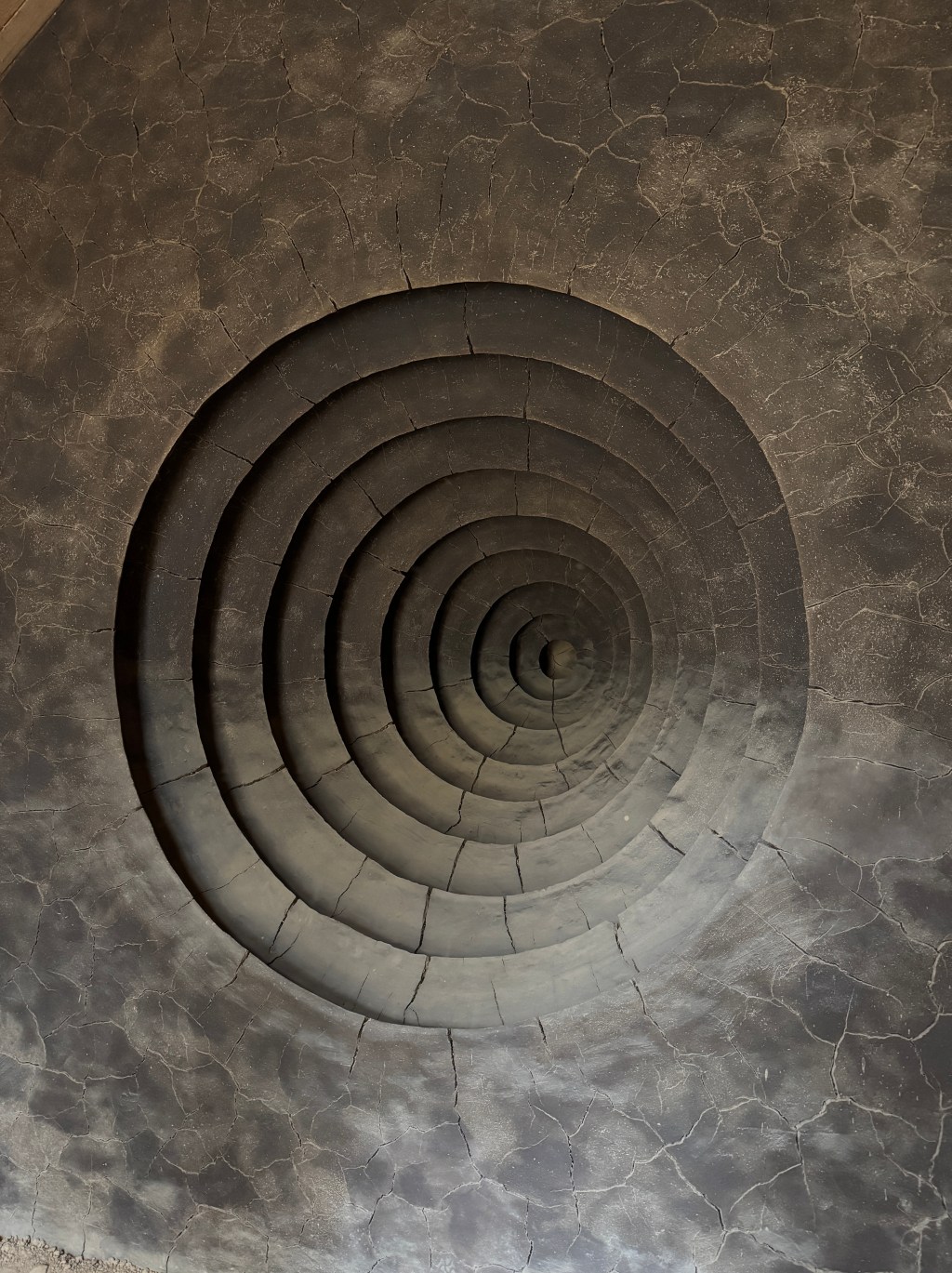
Photo: I’m still a little obsessed with Glenstone. I went back with my husband and they opened the doors behind Andy Goldworthy’s Clay Houses when I was there. The first time I visited Glenstone, the doors of the Houses were closed. My friend and I thought that perhaps they were empty. Well no, they have more art within and the are very cool. I won’t show you the other two. This one, in the third cabin, is Holes. It’s made of a plaster made from hair and the soil of the grounds around the museum campus. It’s mesmerizing from afar and then a touch surreal and even grotesque up close (the hair… the haaaair….). And I share all of this because I am writing a story collection in which the unconventional use of human hair is a part of every story… so this is important. This right here is a physical manifestation of what I’m going for in my stories: mesmerizing from afar (as a whole) and then a bit grotesque, surreal, haunting up close. Art is just… my favorite thing.
The more I teach, the older I get, and the deeper I wade into my storytelling, the more I appreciate the theory behind the practice of my work. This has come to deeper focus lately as I’ve made slides for my winter classes and talked with colleagues for my small literary nonprofit. It’s also formulated as I witness the sustained belligerent conversation we’re having AI slop and what to do about it. (More on that in a minute.) There is that conversation and then there is a conversation before that that kicked off where we’ve ended up and just like so much we’re dealing with right now, I am sitting back with the understanding that the only way out is through. And the through is the theory.
My little nonprofit has a nice catalog of class offerings this winter with a combination of craft topics, diverse teachers, and a good mix of single-session and multi-week classes. I’m proud of what I’ve put together. The biggest offering with the biggest price is our book-in-a-year class offered by an author friend who is going to have her big debut this year. It’s probably the fastest selling class I’ve ever put on the calendar. 15 people signed up right away. I’m really pleased because their tickets completely covered her honorarium (a rarity) and I sincerely think the folk who signed up for going to get a lot out of it. This is all great. Everyone is expressing delight about having a “practical” class on the calendar.
But the 4-week deep dive class on interiority next month put on by a Pushcart-nominated, award winning, highly published author has one ticket sold. This is the second time I’ve put it on the calendar. Matter of fact, all of the craft talks I’ve put on the calendar are getting low attention. When I brought my lament about this to my board, the response was “it would be nice to see more practical classes on the calendar. It’s hard to make a time investment for just craft.”
My response was, “You can write a book in a year, no problem. I think that’s great. But the craft backs up the production. I don’t want y’all to just write books, I want you to write books well.”
This garnered more argument… I have been sitting with that bad taste in my mouth for a few days since. But I’ve also had to do some reflection: have I not felt impatient about “just getting something published?” Did that not result in something good that I’m proud of, but something that ultimately didn’t get as far as I hoped it would? Am I snobby now, with my big-name workshops at my back, telling people they should learn more before they publish stuff? Was I not once a student, sitting in theory classes for teaching, feeling a touch impatient about getting into the classroom? How hard can it be? I just want to do it.
I remember writing a whole entire paper in graduate school expressing this impatience after spending a semester thinking about how we teach thinking. “Where is the moon today?” We were asked each week. “How do you know?” Haughty and 22, I couldn’t believe it. I’d grumble through class, was sharp with my classmates. It took me damn near a decade to appreciate what that class gave to me as a mother and a teacher.
Hindsight. Maturation. Humility. I deeply regret how much I sucked in my 20s.
Maybe I am just getting old, but I love theory. I love falling back on it. I love asking my students to start within themselves. I did a whole class on Wednesday asking my story collection students to think about the purpose of storytelling, their intentions around their art, about the things they know to be true and how they want those truths to resonate with their readers… I asked them to think about characters who moved mountains for them and artists they want to be “in conversation” with in their own art. I asked them over and over again, in different language: who are you, what do you know to be true, what do you think and how do you know? I’ve done this with my students for years. It result is always better writing and more confident writers.
This is the hot take for this post: I think the rise of profitable industry around indie-publishing authors has made for deep impatience with theory and craft, high demand for only practicality. Books have been written. Some of them are even good. Many more of them are… not (at worst) or, as my teens say, mid (at best). We treat stories as a commodity and perhaps, in the end, stories are a commodity… we sell them, we place value on them, we judge why some stories are highly prized and others are left to (impoverished) obscurity. Perhaps I’m thinking too deeply about this. What I will say is that because we’ve done that, made stories mere content, made them easily put out there for quick profit… those who are new to the worksimply see the end result, not the “friends” they are supposed to “make along the way.” The result is blockbuster practical classes and craft classes catching dust, and books at the end of the year that will be done, but might not necessarily be satisfying.
But at least they are taking the practical classes, holding control of their art near to themselves. I can’t fault them for that. Perhaps I even laud them for that.
Because the AI slop stuff is just further down the impatience rabbit hole. We know this. I’m not going to actually waste a lot of pixels on it. I hate the way we’re approaching the conversation about this. I hate the Bsky posts, I hate the chatter amongst colleagues and acquaintances. I sincerely don’t want to hang out with people digitally or in-person right now because it comes up, it’s belligerent, and it does nothing to move needles. I agree that AI is stupid and destructive and detrimental and it’s not part of my practice. The use of it, especially in storytelling, removes the entire point of the art form. That said: I’ve watched people I otherwise admire act absolutely abhorrently publicly and privately about the topic. It makes me want to leave spaces. It makes me want to not enter others. We can be right and so wrong in our righteousness. It just makes for rooms without oxygen and problems with no resolution.
Ultimately, I do think the two are connected. “You don’t have to wait for the gatekeepers to choose you” created a race to get readers and profits no matter the results. That turned into “Writing isn’t actually a skill and ‘creativity’ is a lie. Every idea has a value. Just get it out fast and make your money and move on.” Both result in less than what we deserve.
Ultimately, both take away the most important questions we ask as humans: “Why?” Why are you telling this story? Why are you choosing these characters? Why did you put them in this setting, on this journey, making these choices? Why should we care? Why are you the best person to teach us this lesson? Why should we trust you with a bit of our time and our humanity today?
That’s the intersection of the theory and the practice. Once you can start answering those why questions, you know you’re onto something good. This is the lesson I’m ultimately trying to impart on my students: you sit at the intersection of theory and practice. You are the heart and the engine of your work. Nothing can give that to you, nothing can take that away from you, no one else can explain that about your work, there is no work without a bit of you in it. How you choose to apply that theory (the literal choice of that application) in your storytelling is a reflection of how you understand it. It’s kinda beautiful, actually. Perhaps because it’s the most human thing we can possibly do.
Anyway… I have a whole mountain of rejections to prove that I am no scion of craft, no oracle of storytelling, nor literary genius of any kind. I’m a woman sitting at her desk on a snowy morning, quiet thoughts swirling around me as the coffee jogs my brain into function. I’m going to sit by a fire and read a little about craft today… and then think about how I’ll present it to my students this week. That’s another thing I’ve learned: I write better when I’m teaching. I’m most human when I’m teaching. It’s one thing to learn something for yourself, it’s another thing to pass it on to others.
In a time of fast, impatient, too-easy, cheap commodification (resulting in deterioration of everything we hold dear), won’t you consider the alternative? Slow down. Read. Ask why. Contemplate theory. Go see some art. Go make art. Make it well. Go learn. Go be weird. Go teach something you know. It all matters.
And go make something with hair and dirt, maybe?
(LOL maybe not.)
(But… maybe?)
 Multiplicity: A Writer's Blog